

From Manufacturing Line to Millionaire
The Journey of Klarna Co-Founder Niklas Adalberth
Shane Brown
11/5/20255 min read

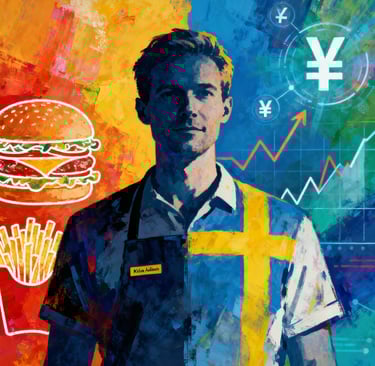
From Manufacturing Line to Millionaire: The Journey of Klarna Co-Founder Niklas Adalberth
In tech entrepreneurship, few stories match Niklas Adalberth's rise. Born in 1981 in Uppsala, Sweden, his path from fast food worker to co-founder of Europe's most successful fintech companies shows how far you go when you start from nothing.
The Burger King Beginning
Adalberth's journey started behind a Burger King counter. As a teenager, he worked the manufacturing line with his childhood friend Sebastian Siemiatkowski. Between shifts, they dreamed bigger and discussed business ideas that would eventually reshape financial technology.
Before Burger King, Adalberth showed entrepreneurial instincts in junior high. He made money forging ID cards and government coupons. When authorities caught him, he learned three lessons: starting a business is fun, not hard, and everyone does it. But you never want to be on the wrong side of the law.
Education and the Eureka Moment
After Burger King, Adalberth attended Stockholm School of Economics. Sebastian joined him there. They met their third co-founder, Victor Jacobsson.
Before business school, Adalberth and Siemiatkowski took a gap year. They bartended across Europe, failed to get cruise ship jobs in Florida, and waited tables at a Swiss ski resort. They tried hitchhiking around the world but got stranded in Sydney when they missed the last cargo ship to Los Angeles.
Siemiatkowski later told Sequoia Capital: "We had to spend a full month in a foreign city, unsure what we would do or how we would support ourselves. We eventually found cheap hostel beds and jobs as furniture movers. We proved to ourselves we could be resourceful."
When they returned to Sweden in 2003, they had missed the deadline to re-enroll in business school. Siemiatkowski lived on welfare checks and eventually found work at a factoring company. He noticed merchants wanted customers to pay via debit card at checkout to guarantee payment. He wondered: what if there was a middleman who paid the seller at checkout and collected payment from the consumer upon delivery?
The seed for Klarna was planted.
The Birth of Klarna: No Money, No Tech Experience, Just Determination
In 2005, while still students, the trio entered their school's entrepreneurship competition with a "buy now, pay later" payment solution they called Kreditor. They finished second to last. Judges dismissed the idea, saying "the banks will never do it."
Most people would have stopped there. But not these three young men with no money, no technical expertise, and no experience in financial services.
"My expertise came from flipping burgers at Burger King. That's all the knowledge I had when we started this business," Adalberth later admitted. "This was a good thing because it made us rethink everything."
The team met Swedish angel investor Jane Walerud at a networking event. Walerud had sold her previous company Bluetail for $152 million. She saw promise in their vision. She invested €60,000 for a 10% stake and introduced them to five software developers who would build their initial platform in exchange for 37% of the company.
Giving away 47% of their company before launching was painful. But Adalberth explained: "We wanted to build something big."
Building Without a Blueprint
In February 2005, the three co-founders got to work. None had a technical background. Managing engineers was a challenge. Adalberth later described their approach: "We worked a lot. I think we spent on average 85 hours a week the first three years."
On April 10, 2005, at 11:06:40 am, Klarna processed its first transaction at a Swedish bookshop called Pocketklubben. The innovation wasn't technological. It was a business model innovation.
The early years were grueling. The team operated as a sales and marketing business, cold calling merchants to offer their payment solution. Adalberth recalled working through scorching Swedish summer days without air conditioning while their friends relaxed at the beach.
The Rocket Ship Takes Off
In 2007, Swedish venture capital firm Investment AB Öresund invested $2.2 million. Over the next few years, Kreditor expanded to Norway, Finland, and Denmark. In 2009, the company rebranded to Klarna.
The turning point came in 2010 when Sequoia Capital invested in Klarna's Series B round at a $100 million valuation, acquiring 25% of the company. That year, Klarna reached $54 million in annual revenue and expanded to Germany and the Netherlands.
By 2011, Klarna secured $155 million from General Atlantic and DST Global. In 2013, Klarna achieved unicorn status with a valuation of €1 billion.
The Exit and the New Mission
Despite Klarna's success, Adalberth experienced a personal crisis. In 2015, after spending a third of his life building the company, he stepped down from his operational role as Deputy CEO. He remained on the board but shifted his focus to social entrepreneurship.
"When I started Klarna, I had this belief that money correlated with happiness," Adalberth later admitted. "It was egotistic from the start." Even as Klarna reached a peak valuation of $45.6 billion in 2021, Adalberth discovered that wealth alone provided no meaning.
Adalberth had accumulated significant wealth selling shares over the years. In 2017, he sold additional shares to fashion holding firm Brightfolk. But rather than pursuing more wealth, Adalberth made an extraordinary decision: he donated approximately $125 million, almost half of his personal wealth, to launch the Norrsken Foundation in 2016.
"I initially donated half of my wealth, $125 million," Adalberth explained. "I knew from the effective altruism movement you save a life for about $4,500. So, it's a lot of lives I could save with that endowment."
The Norrsken Foundation focuses on helping entrepreneurs solve the world's greatest challenges: poverty, famine, mental health, pollution, and climate change. What started as a philanthropic foundation evolved into a comprehensive impact ecosystem, including venture capital funds and co-working spaces in Stockholm, Kigali, and Barcelona.
By 2024, Norrsken had raised over €800 million, made close to 200 investments, and created the largest co-working hub for impact entrepreneurs in Europe. In late 2024, Norrsken VC closed its second fund at €320 million, making it Europe's largest early stage generalist impact fund.
The Klarna IPO: Full Circle
In September 2025, Klarna went public on the New York Stock Exchange, raising $1.37 billion and achieving a market capitalization of approximately $17.5 billion on its first day of trading. Over 40 current and former employees became millionaires.
Adalberth sold approximately 273,000 shares during the IPO, netting about $11.7 million. His remaining stake was valued at approximately $8.6 million. While modest compared to CEO Siemiatkowski's $920 million stake or co-founder Jacobsson's $1.1 billion position, Adalberth's financial gains from Klarna enabled his larger mission with Norrsken.
Lessons from a Burger King Worker Turned Impact Investor
Niklas Adalberth's journey offers powerful lessons for you as an aspiring entrepreneur:
Humble beginnings don't determine your ultimate destination. Working at Burger King as a teenager didn't limit Adalberth's ambitions. Those experiences built work ethic and sparked conversations with a like minded friend that eventually led to a billion dollar company.
Resilience matters more than credentials. The trio behind Klarna had no technical expertise, no financial industry experience, and no money when they started. They finished near last in a business competition. People told them their idea would never work. Yet they persevered.
Giving up equity to gain the right resources pays off. Surrendering 47% of their company before launch in exchange for seed funding and technical talent allowed Klarna to get built. Adalberth understood that owning a smaller piece of something big beats owning all of nothing.
Learning what you don't know is essential. Adalberth didn't pretend to understand engineering. He asked engineers to show him their work, sought advice from other CTOs, and continuously learned. This humility enabled him to manage teams whose skills he didn't initially possess.
Success creates the opportunity to give back. Rather than simply accumulating wealth, Adalberth redirected half his fortune toward solving global challenges through the Norrsken Foundation. His evolution from profit focused entrepreneur to impact driven philanthropist demonstrates that the ultimate measure of success may not be what you gain, but what you give.
From forging IDs as a teenager to flipping burgers at Burger King, from hitchhiking across continents to building one of Europe's most valuable fintech companies, from achieving billion dollar success to donating half his wealth, Niklas Adalberth's story proves extraordinary journeys start in ordinary places. His legacy extends beyond Klarna's payment innovations to a broader vision: using entrepreneurship and technology as forces for positive global impact.